





AI Ops

Your team builds AI. We make sure it runs. We deploy, secure, and operate it in your infrastructure — under your control — so your engineers go back to building product instead of keeping a model alive.

In your infra

deployed on your cloud or on-prem
— never a black box

On-call

monitoring, alerting, and incident response, not silence until it breaks

Full ownership

of security, access control, and compliance configuration

Structured intake

scoped before any work
begins — no surprises

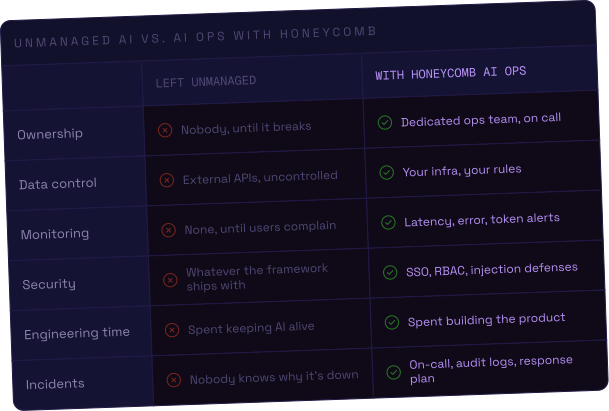
Unmanaged AI vs AI Ops with Honeycomb comparison
The situation

Most companies have AI.
Few have it running reliably.

AI Ops is the practice of reliably deploying, securing, monitoring, and operating AI systems — including third-party APIs and self-hosted LLMs — across private cloud or on-premise infrastructure. Honeycomb Software provides AI Ops as a managed service: infrastructure setup, model deployment, security & access control, monitoring, and safeguards against prompt injection and policy violations, delivered as a short-term deployment, an ongoing operations retainer, or both.

In most companies we talk to, AI still lives on a developer’s laptop or in a test environment — a working prototype nobody has actually operationalized. That’s fine for a demo. It’s not fine for something the business now depends on.

What we do

Six things we take off your plate

Infrastructure Setup

The foundation the AI actually runs on — cloud or on-prem, sized and networked correctly from the start.

  • AWS / Azure / GCP / on-prem
  • Kubernetes cluster provisioning
  • Network, access & firewall config
  • Hybrid cloud + local model routing

AI Model Deployment

Whichever model fits — hosted API or self-hosted — deployed and tuned for real production traffic.

  • OpenAI, Anthropic, Gemini via API
  • Self-hosted: Llama, Mistral, custom
  • Inference optimization & region setup

LLM Configuration

The controls that keep usage predictable — who can call what, how much, and what happens when a model fails.

  • Per-team / per-user token limits
  • Model fallback & cost routing

Security & Access

Who can reach the model, with what data, and a full trail of who did what — before anything goes wrong.

  • SSO (SAML / OIDC) + MFA
  • RBAC, audit logs, data isolation
  • Per-role access to models & data

Monitoring & Ops

Someone watching the model 24/7 — so an outage shows up as an alert, not a customer complaint.

  • Latency, errors, token usage alerts
  • SIEM integration if required
  • Incident response & on-call support

AI Safeguards & Policies

Guardrails on what the AI is allowed to do and see — so a prompt injection doesn’t become a data breach.

  • Prompt injection & jailbreak protection
  • Output filtering & content policies
  • Compliance: GDPR, HIPAA, PCI
What's in demand right now

The market is moving fast.
We deploy what clients actually need.


Private LLM deployment

Run Llama, Mistral, or custom models locally — no OpenAI dependency.

AI agents in production

Orchestration, memory, tool use — deployed and monitored reliably.

Usage limits & cost controls

Per-team or per-user token limits, model routing, spend alerts.

RAG on internal data

Connect AI to company documents, wikis, and CRMs — securely.

Multi-model fallback

If one model is down or expensive, traffic switches automatically.

Who this is for

You're probably a fit if…

AI Ops isn't for every company with a chatbot. It's for teams where AI has become — or is about to become — something the business depends on.

You have a pilot stuck in staging

It works on your laptop. Nobody knows how to take it to production without it falling over or leaking data.

Assessment + Deployment

You handle regulated or sensitive data

GDPR, HIPAA, PCI, or data residency rules mean the AI can't just call a public API and hope for the best.

Security & Safeguards

You already have AI in production — unmonitored

It mostly works, but nobody would know if it stopped. There's no on-call, no alerting, no owner.

AI Operations Retainer

Your engineers are your ops team, by default

Whoever built the AI is also the one who gets paged. That's not a sustainable division of labor.

Full Cycle Partnership
How we onboard a client

Structured intake. No surprises.

Step 1 of 4: Contacts & Timeline

Contacts & Timeline

Who owns this on your side, and when it needs to happen.

  • Technical sponsor
  • Security contact
  • DevOps contact
  • Kickoff & go-live dates
  • Change windows & freeze periods

Client fills a structured intake formwe scope effort, roles, and timeline before any work begins.

How we engageShort-term or ongoing. Your client chooses.

How we structure an AI Ops engagement depends on whether the need is a one-time deployment, ongoing operational ownership, or both.

Short-term

Assessment + Deployment

2–8 weeks

  • Audit current AI setup
  • Deploy to production
  • Security & access config
  • Handover to internal team
Ongoing

AI Operations Retainer

Monthly

  • Monitor & maintain models
  • Handle incidents
  • Optimize cost & performance
  • Update models as needed
Long-term

Full Cycle Partnership

By milestones

  • Deploy → operate → improve
  • Dedicated ops team
  • Embedded in client workflows
  • Quarterly reviews & upgrades
When clients come to us

Real trigger points

Nobody calls us because AI Ops sounded interesting. They call because one of these happened.

Prompt injection via user file

A user uploaded a document to the AI assistant. Hidden instructions inside changed the agent's behavior and exposed sensitive data.

Model costs out of control

The OpenAI bill doubled last month. No visibility on who's calling what. Engineers can't explain the spend.

Pilot stuck in staging

The AI prototype works great locally. But nobody on the team knows how to take it to production safely.

Data can't leave the country

Legal blocked the cloud AI rollout. GDPR, HIPAA, or local data residency means they need on-prem or private cloud.

AI is down, nobody knows why

The model started returning errors at 2am. No monitoring, no alerting, no on-call. The customer found out first.

No guardrails on the agent

The AI agent started calling APIs it shouldn't. No output filtering, no policy enforcement, no audit trail.

Scaling killed performance

10 users worked fine. At 200, latency spiked and the model started failing. No infra to absorb the load.

Results

What AI Ops looks like in practice

Fintech: AI pilot went from laptop to production in 3 weeks

A fintech's AI assistant worked in demos but nobody would sign off on running it in front of real customers — no monitoring, no access control, no owner. We deployed it into their own AWS account with SSO, RBAC, and alerting configured from day one.

3 wks

staging to production

0

unmonitored incidents since go-live

HR tech: brought a doubling AI bill under control in one sprint

Monthly model spend had doubled with no way to trace which team or feature was driving it. We introduced per-team token limits, model routing, and spend alerts, then moved a high-volume workflow to a cheaper fallback model with no user-visible change.

1 sprint

to full cost visibility

Flat

monthly spend since routing went live

Healthcare platform: private LLM deployment cleared legal review

Legal had blocked a cloud AI rollout over patient-data residency. We deployed a self-hosted model on the client's own infrastructure — no data ever reached an external API — and configured HIPAA-aligned access controls and audit logging.

On-prem

deployment, zero external API calls

Cleared

legal & compliance review on first pass

If they ask what we do —

We deploy it. We secure it. We keep it running.

In your infrastructure. Under your control. We own the operations.

FAQ

Questions we get asked

Honest answers to the questions clients ask before handing over their AI infrastructure — what changes, who owns what, and how fast we can start.

  1. AI Ops is the discipline of deploying, securing, monitoring, and operating AI systems in production — the same way DevOps does for traditional software. It covers infrastructure setup, AI model deployment, LLM configuration, security and access, monitoring and incident response, and safeguards against prompt injection, jailbreaks, and policy violations. We deliver all of it as a managed engagement in your own infrastructure.

  2. Calling a model API gets a prototype working. It doesn't provide access control, per-team usage limits, monitoring, incident response, prompt-injection defenses, audit logs, or compliance configuration — all of which production systems need once real users and real data are involved. AI Ops is the operational layer around the model: the parts that determine whether it keeps running reliably once it leaves a developer's laptop.

  3. Yes. We deploy on AWS, Azure, GCP, or fully on-prem, including air-gapped environments with no internet access. For on-prem or air-gapped deployments we work with self-hosted models — Llama, Mistral, or custom fine-tunes — provisioned on Kubernetes with your GPU/VRAM constraints factored into the setup. You own the environment; we configure and operate within it.

  4. We configure output filtering and content policies, enforce per-role access to models and data, and set up detection for prompt-injection patterns — including indirect injection via uploaded documents or connected data sources. This sits alongside standard access controls: SSO (SAML/OIDC), MFA, RBAC, and audit logging, so every model interaction is attributable and every anomalous pattern is visible before it becomes an incident.

  5. We configure deployments to align with GDPR, HIPAA, and PCI requirements — including data residency, PII/PHI/PCI scoping, and audit logging. Where you already run a SIEM, we integrate AI monitoring events into it. Compliance requirements are captured during intake, before any infrastructure work begins.

  6. Yes. For clients who need to keep data out of external APIs — for cost, compliance, or data-residency reasons — we deploy self-hosted models such as Llama, Mistral, or custom fine-tunes on your own infrastructure, with inference optimization and region setup handled as part of the deployment. We also support hybrid setups that route between a self-hosted model and a cloud API as a fallback.

  7. That's what Monitoring & Ops and the AI Operations Retainer exist for. We set up latency, error, and token-usage alerting, and provide incident response with on-call support — so an outage is caught by monitoring, not reported by a customer. Multi-model fallback can also be configured, so traffic reroutes automatically if a model is down, degraded, or too expensive to keep using.

  8. We offer three models: Assessment + Deployment is a short-term engagement (2–8 weeks) to audit the current setup, deploy to production, and hand over to your internal team. The AI Operations Retainer is an ongoing monthly engagement to monitor, maintain, and optimize AI already in production. Full Cycle Partnership combines both as a long-term engagement with a dedicated ops team. We'll recommend which fits on the intake call.

  9. You fill a structured intake form covering contacts and timeline, deployment target, auth/repo/security requirements, and LLM/inference needs. We use that to scope effort, roles, and timeline before any work begins — so there are no surprises once the engagement starts. Actual start dates depend on deployment complexity and specialist availability, confirmed during scoping.

  10. Not necessarily — this is one of the most common ways clients engage us. We start with an assessment of the current setup: where it's deployed, what monitoring exists (if any), what security and access controls are in place, and where the reliability gaps are. From there we scope the specific fixes needed rather than assuming a ground-up rebuild is required.

  11. The terms overlap but emphasize different things. MLOps traditionally covers the lifecycle of training and retraining machine learning models. LLMOps is a narrower term specifically about operating large language models — prompting, fine-tuning, evaluation. AI Ops, as we use it, is the broadest and most practical term for companies: it covers everything needed to run any AI system reliably in production — infrastructure, model deployment, security, monitoring, and safeguards — regardless of whether the underlying model is a hosted LLM API, a self-hosted open-weight model, or a custom ML pipeline.

  12. Both. Startups typically come to us with a pilot stuck in staging and need an Assessment + Deployment engagement to get it into production safely and quickly. Larger and regulated companies more often need the AI Operations Retainer or Full Cycle Partnership, with heavier emphasis on compliance, access control, and on-call coverage. The engagement model scales to the company's size and risk profile — we scope it on the intake call rather than applying a one-size-fits-all package.

Get started

Tell us about your AI setup

Book a 45-minute call with an AI Champion — a technical AI Ops lead who'll walk through what's currently running, where it lives, and what a realistic deployment or hardening plan looks like.

  • 45-min call with an AI Champion — a technical AI Ops lead, not a scripted pitch
  • We'll tell you honestly what needs fixing and what doesn't
  • No commitment — we agree on scope before anything starts

We are extraordinarily grateful for their hard work, expertise, and professionalism.

Hunter HonnessyCTO, SaaS Company
Book a call

45 minutes. We'll review what you tell us beforehand and come prepared.

    No spam. We reply within 24h and schedule a 45-min call.

    Thank you for reaching out!

    We’ll review your message and get back to you soon. In the meantime, feel free to explore our case studies or submit another request.